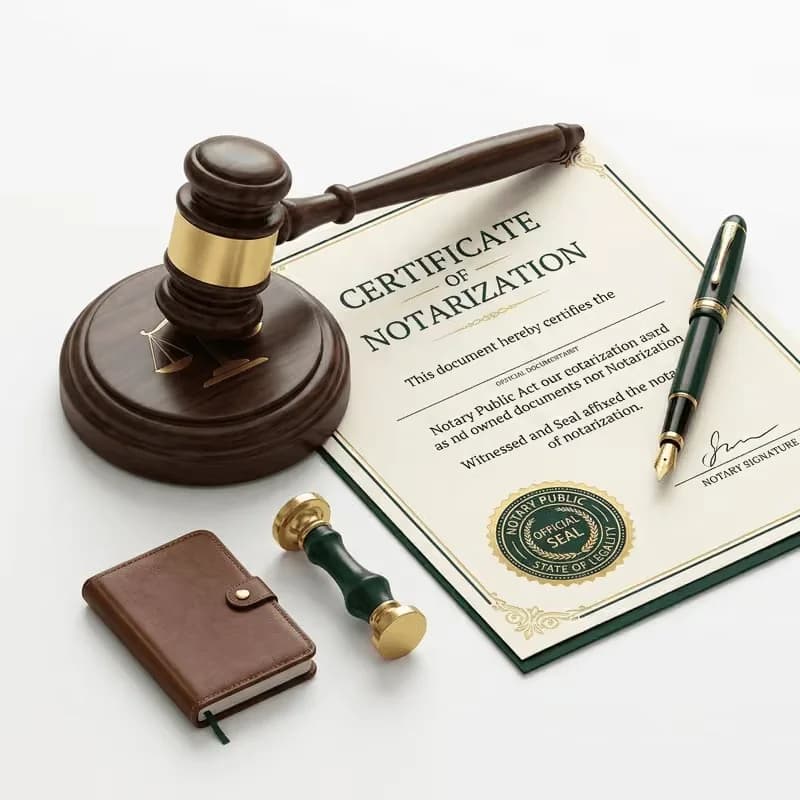
Notarization in the UAE is the formal process of having an authorised notary verify signatures, identities, and certain legal documents so they can be used for official or legal purposes. Depending on the document and transaction, notarization may be required for a Power of Attorney, contract, declaration, company document, or another legal instrument.
The exact procedure can vary depending on the document, the emirate involved, and how the document will be used. The UAE Ministry of Justice provides official Notary Public and Authentication services, including electronic notary services.
Understanding the process before submitting your documents can help you avoid missing paperwork, translation issues, and unnecessary delays.
What Is Notarization in the UAE?
Notarization is the official authentication of a document or signature by a legally authorised notary.
A notary verifies the identity of the parties involved and, where applicable, their authority or legal capacity before completing the notarization. The process provides greater legal authenticity to the document and helps establish that the relevant person signed or authorised it.
Notarization is different from translation and document attestation. However, these services may sometimes be required together depending on the purpose of the document.
Notarization vs Translation vs Attestation
Service | Main Purpose |
Translation | Converts a document from one language into another accurately |
Notarization | Authenticates signatures or certain legal documents through an authorised notary |
Attestation | Verifies the authenticity of signatures and seals for official use |
Certified Legal Translation | Provides a translation suitable for official or legal submission where certification is required |
For example, a foreign-language document may require a legally acceptable Arabic translation before it can be submitted for notarization.
Which Documents May Need Notarization in the UAE?
Not every legal document requires notarization. The requirement depends on the transaction and the authority receiving the document.
Common documents that may require notarization include:
Power of Attorney (POA)
Memorandum of Association (MOA)
Commercial agreements and contracts
Declarations and undertakings
Affidavits
Signature-related documents
Company resolutions
Meeting minutes
Judicial or legal notices
Non-Muslim wills
Certain ownership-related agreements
The purpose of the document is an important factor. A POA used for a property transaction may have different requirements from a declaration prepared for a business or government procedure.
Before starting the process, confirm the requirements applicable to your specific document.
How Does the Notarization Process Work in UAE?
The notarization process generally involves document preparation, identity verification, submission, payment, and final authentication.
1. Determine Why the Document Needs Notarization
First, determine why the document needs to be notarized and which authority, organisation, or individual will receive it.
For example, a Power of Attorney may be required for:
Property transactions
Banking matters
Legal proceedings
Business activities
Representation before authorities
Knowing the intended use helps establish whether you need notarization alone or additional services such as translation, drafting, or attestation.
2. Prepare the Required Documents
Gather the original document and all identification and supporting documents required for the transaction.
Depending on the circumstances, these may include:
Valid passport
Emirates ID
Original legal document
Supporting documentation
Company documents
Existing authorisation documents
Certified translation, where applicable
The requirements can differ according to the type of notarization.
3. Arrange Legal Translation if Required
Foreign-language documents may require Arabic translation before they can be accepted for certain legal or official procedures.
Translation is especially important for legal documents because names, dates, clauses, monetary amounts, and powers granted must be reproduced accurately.
A legal translation should preserve the meaning and legal context of the original document rather than simply translating individual words.
If you need help with document translation, Fimkin provides Translation Services UAE for documents intended for official and legal use.
4. Submit the Notarization Application
The applicant or authorised representative submits the document and required information through the applicable notary service.
The UAE Ministry of Justice provides online services and an E-Notary system. Depending on the transaction, parts of the process may be completed electronically.
Applicants should check the current requirements before submitting their documents because procedures can change.
5. Complete Identity Verification
The notary reviews the submitted information and verifies the identity of the parties involved.
The parties may need to confirm their identity, consent, and legal capacity before the document can be notarized.
For corporate documents, additional verification may be required to establish that the person signing has the authority to represent the company.
6. Pay the Applicable Fees
Once the transaction is accepted, the applicable government or notary fees must be paid.
Fees vary depending on the type of document and service. It is therefore advisable to check the current official fee information before proceeding.
7. Receive the Notarized Document
Once the notary completes the transaction, the notarized document is issued through the applicable process.
Depending on the service, the final document may be provided electronically or through another approved delivery method.
What Documents Are Needed for Notarization?
The documents required depend on the type of transaction, but applicants commonly need valid identification and the document requiring notarization.
A basic preparation checklist may include:
Original passport
Valid Emirates ID, where applicable
Original document
Supporting documents
Proof of authority for company transactions
Certified Arabic translation, where required
Additional approvals specified by the relevant authority
For corporate transactions, company incorporation documents, board resolutions, or other authorisation records may also be required.
Tip: Do not assume that the main document alone will be sufficient. Missing identification, supporting paperwork, or translations can delay the process.
Power of Attorney Notarization in the UAE
A power of Attorney is one of the most common documents requiring notarization.
A POA allows one person to authorise another person to act on their behalf for specific matters. The authority granted can relate to property, banking, legal proceedings, business activities, or other approved purposes.
The wording of the POA is particularly important because unclear or incomplete clauses can create difficulties when the document is used later.
A professionally prepared POA should clearly identify:
The person granting the authority
The authorised representative
The specific powers being granted
Any limitations
Relevant conditions
Duration, where applicable
The purpose of the authorisation
When drafting involves complex legal powers or multiple languages, professional assistance can help ensure that the document is prepared appropriately.
Fimkin also provides support for Power of Attorney drafting and notarization as part of its legal documentation services.
Does a Foreign-Language Document Need Arabic Translation?
A foreign-language document may need to be translated into Arabic before it can be accepted for certain UAE legal or official procedures.
The exact requirement depends on the authority and purpose of the document.
Translation accuracy is particularly important for notarization because an error in a person's name, date, legal clause, amount, or authority granted can change the meaning of the document.
A qualified legal translator should understand both the source language and the relevant legal terminology.
This becomes especially important for documents involving:
Courts
Government authorities
Commercial transactions
Immigration
Property
Legal representation
Corporate matters
Using an appropriate legal translation before notarization can help reduce the risk of corrections or rejection.
How Long Does Notarization Take in the UAE?
The processing time for notarization depends on the document, authority, transaction complexity, and whether additional services are required.
Straightforward transactions may be completed relatively quickly when all required documents are correctly prepared. More complicated cases can take longer if they involve legal drafting, translation, company documentation, external attestation, or additional approvals.
If both translation and notarization are required, arranging the translation in advance can help avoid unnecessary delays.
For time-sensitive documents, confirm the current processing requirements with the relevant authority or professional service provider before making arrangements based on a specific deadline.
What Are the Common Notarization Mistakes to Avoid?
Many delays can be prevented by preparing the document correctly before submission.
Common mistakes include:
Using outdated identification documents
Submitting incomplete paperwork
Spelling names differently across documents
Providing inconsistent passport or Emirates ID details
Using an unsuitable translation
Failing to provide supporting documents
Assuming every document follows the same procedure
Not checking whether additional attestation is required
Using unclear wording in a Power of Attorney
Waiting until the last minute to arrange translation
A document review before submission can help identify inconsistencies and missing requirements.
When Should You Use Professional Notarization Support?
Professional assistance can be useful when a document involves complex legal terminology, multiple languages, business interests, overseas use, or several connected government procedures.
This can be particularly helpful for:
Business owners
Companies handling corporate documentation
Individuals granting a Power of Attorney
Property owners and buyers
Expatriates managing affairs remotely
Individuals preparing documents for overseas use
Clients who need translation and notarization together
Professional support can also help when you are unsure whether your document requires notarization, legal translation, attestation, or another form of certification.
Fimkin provides legal translation and document services in the UAE for clients who need accurate translation and careful handling of official documents.
You can also learn more about the company's background and approach through About Fimkin Translation.
If your document requires attestation in addition to notarization, check the latest requirements through the UAE Ministry of Foreign Affairs attestation service.
Fimkin Translation: Your Legal Documentation Partner in the UAE
Fimkin Translation is a UAE-based translation and legal documentation service provider offering legal translation, certified translation, notarization, document attestation, and related language services for individuals and businesses.
The company supports legal, corporate, personal, and official documents intended for use with UAE authorities, courts, businesses, and other organisations. Its services focus on accurate translation, confidential document handling, and support with documentation requirements for official use.
For documents that require both translation and notarization, coordinating these requirements correctly is important. Fimkin provides legal translation and notarization-related support to help clients prepare their documents accurately and understand the applicable process.
Whether you need assistance with a Power of Attorney, contract, agreement, declaration, company document, or another legal document, Fimkin can help with the relevant translation and documentation requirements.
Clients who have questions about document translation, notarization, or related services can also review the Fimkin FAQs for additional information.
Need Help With Notarization in UAE?
Notarization becomes easier when the document, identification, translation, and supporting paperwork are prepared correctly before submission.
If your document is in another language, requires legal drafting, or needs to be used for a business, court, property, or personal matter, professional assistance can help you identify the appropriate documentation and translation requirements.
Fimkin can assist with legal translation, certified translation, notarization-related services, and other document requirements in the UAE.
If you are unsure which service your document requires, Contact Fimkin Translation to discuss your requirements.
You can also call Fimkin Translation at +971 52 963 8764 for assistance with your document requirements.
Frequently Asked Questions
1. Is notarization mandatory for every document in the UAE?
No. Not every document requires notarization. The requirement depends on the type of document, transaction, authority, and intended use.
2. Can a foreign-language document be notarized in the UAE?
A foreign-language document may need to be legally translated into Arabic before submission, depending on the applicable authority and transaction. It is advisable to confirm the language requirements before starting the process.
3. Can I notarize a Power of Attorney in the UAE?
Yes. A Power of Attorney can be prepared and notarized for authorised purposes. The required wording, identification documents, translation, and procedure depend on the type and intended use of the POA.
4. What identification is required for notarization?
Requirements vary, but applicants may need a valid passport, Emirates ID, and other supporting documents. Corporate transactions can require additional company and authorisation documents.
5. Is notarization the same as attestation?
No. Notarization and attestation are different processes. Notarization generally authenticates a signature or legal document through an authorised notary, while attestation verifies the authenticity of signatures or seals for official use.